SKIN TIGHTENING & RF TREATMENTS
It's all over your social feed. Celebrities swear by it. The science sounds compelling. So I booked the appointment — and I'm giving you the full, unfiltered report.
By Total Body Aesthetic |
I didn't come into this skeptical. But I didn't come in a believer either.
I'm the kind of person who reads the clinical data before the Instagram caption. So when XERF started flooding my feed — celebrities glowing, dermatologists explaining frequencies, before-and-afters that looked genuinely real — I did what any curious aesthetics-adjacent person does: I booked an appointment. At Total Body Aesthetic in Westchester, Los Angeles.
What followed was one of the most interesting 90 minutes I've spent in a treatment chair. And now I'm going to tell you everything — the device, the science, what it felt like, what I noticed afterward, and whether the hype matches the results.
XERF — short for eXperience Exponential RF — is a monopolar radio-frequency device manufactured by Cynosure Lutronic, the same company behind the Genesis and PicoSure Pro brightening lasers. It debuted in South Korea in 2024 and received FDA clearance for use in the United States in August 2025. In the months since, it has moved fast — from dermatology offices in New York to medical spas in Los Angeles, with a social media presence that's hard to miss.
What sets XERF apart from the crowded field of RF devices is its use of dual frequencies delivered simultaneously. Most tightening devices operate on a single frequency, which means they can only target one layer of the skin at a time. XERF uses two: 6.78 MHz, which works superficially to firm the skin's surface and smooth fine lines, and 2 MHz, which penetrates deeper into the subcutaneous layer to stimulate collagen remodeling and trigger a lifting effect. One treatment, two mechanisms, multiple depths.
The "monopolar" part of the equation refers to how the energy travels through the body. A flat treatment tip applies RF energy to the face, and that energy exits through a grounding pad — essentially a large adhesive bandage — placed on the lower back. It sounds like something out of a science fiction film. In practice, you don't feel the energy traveling at all. But knowing you're essentially plugged in while a handpiece glides across your cheekbones? That's a sensation that takes a moment to get used to.
A cooling system in the tip keeps the surface of the skin comfortable while the deeper energy does its work, which is a key reason why XERF does not require numbing cream — a significant quality-of-life advantage over some competing devices.
One of XERF's most impressive characteristics is its inclusivity. Because the device tip stays cool and the energy is controlled precisely, it is considered safe for all skin types and tones — including patients with melasma, who are often excluded from heat-based treatments due to the risk of hyperpigmentation. Clinical studies by Cynosure Lutronic confirmed efficacy across a wide range of complexions.
At TBA, our providers have found XERF particularly well-suited for patients who:
If you're on semaglutide or another GLP-1 medication and concerned about skin laxity from weight loss, XERF can help — but the degree of benefit depends heavily on how much laxity is present. For patients with moderate-to-significant laxity, we often recommend combining XERF with Sculptra or other biostimulatory fillers to address both the surface and the structural foundation of the skin. Ask us at your consultation.
As with any energy-based treatment, there are people who won't get the most from XERF — or for whom the treatment may not be appropriate at all.
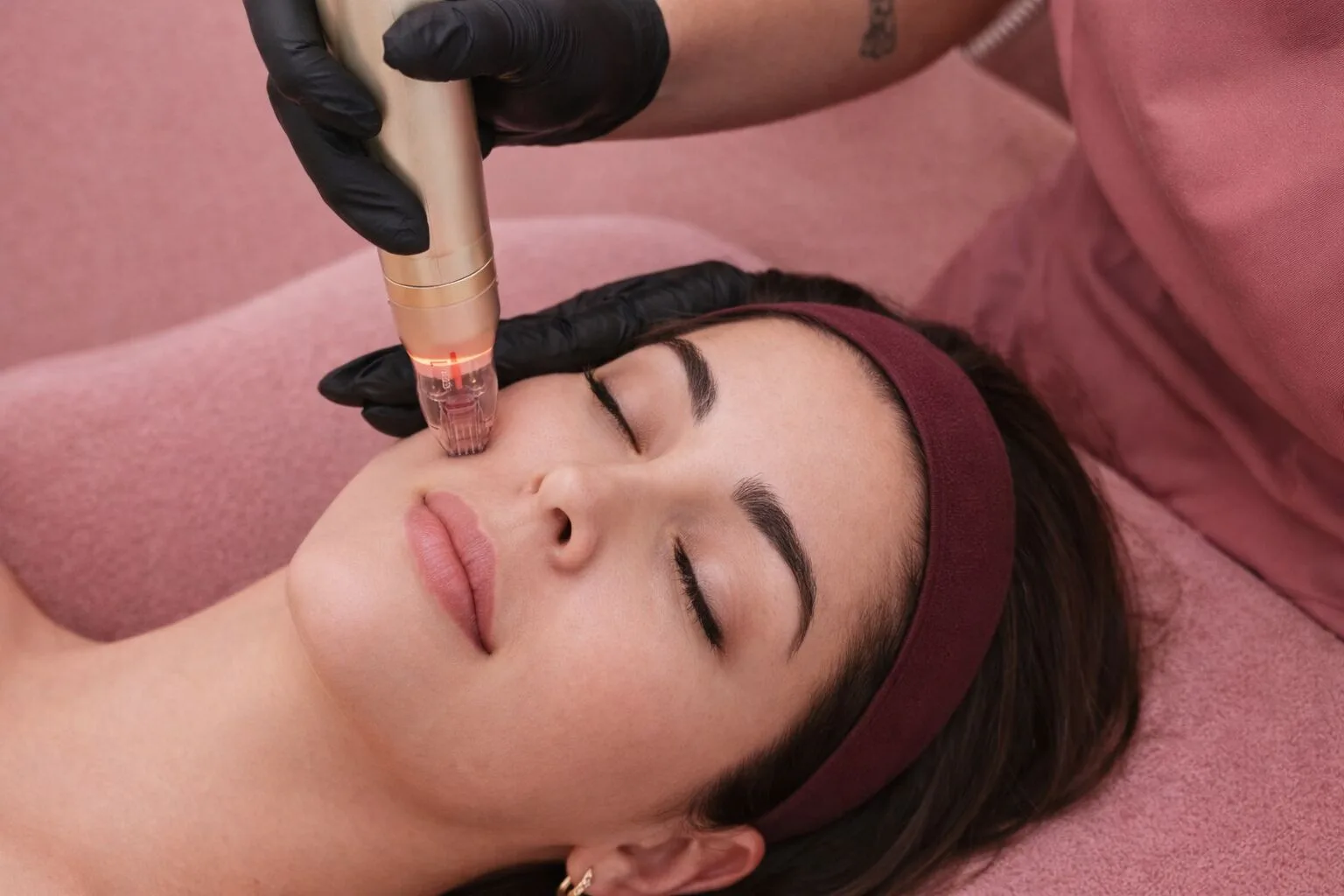
I arrived at TBA without numbing cream — because XERF doesn't require it. That fact alone set a different tone for the appointment. No 45-minute wait with a face full of lidocaine. I was brought into the treatment room, a grounding pad was placed on my lower back (the "plugged in" moment), and my provider applied a generous layer of conductor gel — essentially ultrasound jelly — across my face and neck.
Then the handpiece went to work.
The best description I can offer: a warm stone massage, with occasional pulses of heat that build and then fade. My provider started on the lowest intensity setting and moved in deliberate sweeping passes across the lower face, cheeks, and forehead. Every time the intensity was increased — which happened several times — I was asked first. On the moments it felt warmest, I'd rank the sensation at about a three or four out of ten. It passed quickly.
A full facial treatment consists of approximately 600 pulses — typically 250 to 275 on each side of the face, and around 100 for the forehead. If the neck is included, the session runs to roughly 900 pulses. From start to finish, expect between 45 minutes and an hour for the face alone. My session ran closer to 90 minutes because we worked the neck as well.
When it was over, my skin had the warm, slightly flushed look of someone who'd just come in from a brisk walk — pink, not red. The immediate tightness was noticeable and, honestly, exciting. A sheet mask was applied to calm the skin, and I was out the door within 20 minutes of the treatment ending.
XERF's aftercare is mercifully simple. For the first 24 to 48 hours:
By the time I reached my car in the parking lot at 8610 S Sepulveda, the warmth in my skin had already largely subsided. The next morning, my skin looked like my skin — just a more rested, slightly tighter version of it. No peeling. No raw patches. No canceling plans.
The standard protocol recommended by Cynosure is two sessions, at least one month apart. However, at TBA, our providers typically prefer to space sessions further — three to six months apart — to allow collagen to fully rebuild before the next round of stimulation. Over-treating doesn't accelerate results; it just shortens the window of collagen production between sessions.
What the timeline looks like in practice:
Younger patients tend to see longer-lasting results, as their baseline collagen production is higher. For best long-term outcomes, XERF is ideally viewed as part of an ongoing skin maintenance plan, not a single-event fix.
The landscape of non-surgical skin tightening is genuinely crowded. Here's how XERF stacks up against the devices patients ask us about most often:
| Device | Technology | Numbing | Downtime | Depths Targeted |
|---|---|---|---|---|
| XERF | Monopolar RF, dual frequency | Not required | Minimal (hours) | Superficial + deep |
| Thermage | Monopolar RF, single frequency | Not required | Minimal | Single depth |
| Morpheus8 | RF + microneedling | Required | 3–5 days | Adjustable, needled |
| Sylfirm X | RF + microneedling (pulsed/continuous) | Required | 2–4 days | Adjustable, needled |
| Ultherapy | Focused ultrasound (HIFU) | Recommended | Minimal–moderate | SMAS + skin layers |
XERF's closest competitor is Thermage — both are monopolar RF, both require no numbing, and both have minimal downtime. The key difference is XERF's dual-frequency delivery, which allows it to address surface tightening and deep collagen remodeling at the same time. Thermage uses a single frequency and works at one depth per pass.
Ultherapy reaches deeper — down to the SMAS layer — and can be highly effective for significant lifting, but the discomfort level is considerably higher for many patients. At TBA, we sometimes pair XERF and Ultherapy for patients with greater laxity who want a comprehensive approach: Ultherapy targeting the jawline and outer face, XERF addressing the under-eye area and lines around the mouth that are harder to treat with Ultherapy's larger tip.
Morpheus8 and Sylfirm X combine RF energy with microneedling, delivering more aggressive remodeling at customizable depths. They require numbing and a few days of downtime, but they can address skin texture, pores, and scarring in ways that surface-only RF cannot. Many of our patients use Morpheus8 or Sylfirm X for their remodeling sessions and XERF for lower-downtime maintenance in between.
Absolutely — and this is where the real power of XERF shows up in a comprehensive treatment plan. At TBA, we frequently pair XERF with:
Our team at TBA designs custom treatment plans that often layer XERF with injectables, lasers, and regenerative therapies to address the full picture of what's changing in your skin. No two plans look exactly the same — because no two faces are exactly the same.
A full two-session XERF series typically runs between $1,800 and $2,500 depending on the provider, location, and the scope of treatment (face only vs. face and neck). Single sessions can range from $900 to $1,400. Like most non-surgical skin tightening treatments, XERF is an investment — but for patients who want meaningful results without the cost, risk, and recovery of surgery, it often represents significant value.
At Total Body Aesthetic in Westchester, we offer complimentary consultations so you can understand exactly what you're getting, what to expect, and how XERF fits into your broader skin health goals before you commit to anything.
I'll tell you what I noticed: within a day of my session, my face looked more defined. The jawline I'd been watching soften over the past two years looked sharper. The slightly heavy quality I'd noticed in my mid-face — that subtle downward drift that no amount of good skincare can fully address — felt subtly corrected.
The immediate tightening is real and it's exciting. But the more interesting thing is what happens in the weeks that follow, as the collagen stimulus gradually converts to actual structural change. That's where XERF earns its reputation — not in the dramatic before-and-after of the day of, but in the slow, accumulating firmness that builds over the next two months.
Was I converted? Yes — with a clear-eyed understanding of what it is and what it isn't. XERF is not a face lift. It is not going to reverse decades of aging in one session. But for patients in the right window — those noticing early-to-moderate laxity who want a comfortable, zero-downtime way to bank collagen and visibly lift the skin — it delivers in a way that's hard to dismiss.
I'm already scheduled for my second session.
What is XERF and how does it work?
XERF (eXperience Exponential RF) is a monopolar radio-frequency skin-tightening device by Cynosure Lutronic. It uses two frequencies simultaneously — 6.78 MHz to tighten the superficial skin layers, and 2 MHz to penetrate deeper and stimulate collagen remodeling — making it the only RF device in the world to use dual multifrequency energy. A grounding pad on the lower back allows the energy to travel through the body safely.
Does XERF hurt? Do you need numbing cream?
XERF does not require numbing cream, which is one of its standout advantages. Most patients describe the sensation as a warm stone massage — comfortable with occasional pulses of heat that build and then quickly pass. On a pain scale of 1 to 10, most fall around a 3 or 4 at peak intensity. Your provider adjusts settings throughout and always checks in before increasing intensity.
How many treatments do you need and how long do results last?
The standard protocol is two sessions spaced 3 to 6 months apart. Results from the first treatment typically last 3 to 4 months; results after the second session can last 8 to 10 months. Younger patients tend to see results last longer. Ongoing maintenance sessions help sustain and build upon results over time.
What is the downtime after XERF?
Virtually none. You may notice mild redness and warmth for a few hours post-treatment. Most patients return to normal activities the same day. Avoid saunas, very hot showers, and active skincare ingredients (retinoids, AHAs) for 2 to 3 days. Sunscreen is especially important in the days following treatment.
How does XERF compare to Morpheus8 and Sylfirm X?
Morpheus8 and Sylfirm X combine RF energy with microneedling, which delivers more aggressive remodeling and can address texture, pores, and scarring — but requires numbing and 2 to 5 days of downtime. XERF is surface-delivered, requires no needles or numbing, and has minimal downtime. At TBA, many patients use RF microneedling treatments for intensive remodeling and XERF for lower-downtime maintenance in between.
Can XERF be combined with other treatments at Total Body Aesthetic?
Yes — and combination approaches often deliver the most complete results. XERF pairs well with neurotoxins, Sculptra, Radiesse, Emface, and laser treatments. At TBA, we design personalized protocols that layer treatments strategically to address multiple layers of aging simultaneously: structure, volume, skin quality, and tone.
Total Body Aesthetic is located at 8610 S Sepulveda Blvd, Westchester — serving patients from Playa Vista, Marina del Rey, El Segundo, Culver City, and throughout the South Bay. Schedule a complimentary consultation to find out if XERF is right for you.
Book a Consultation